
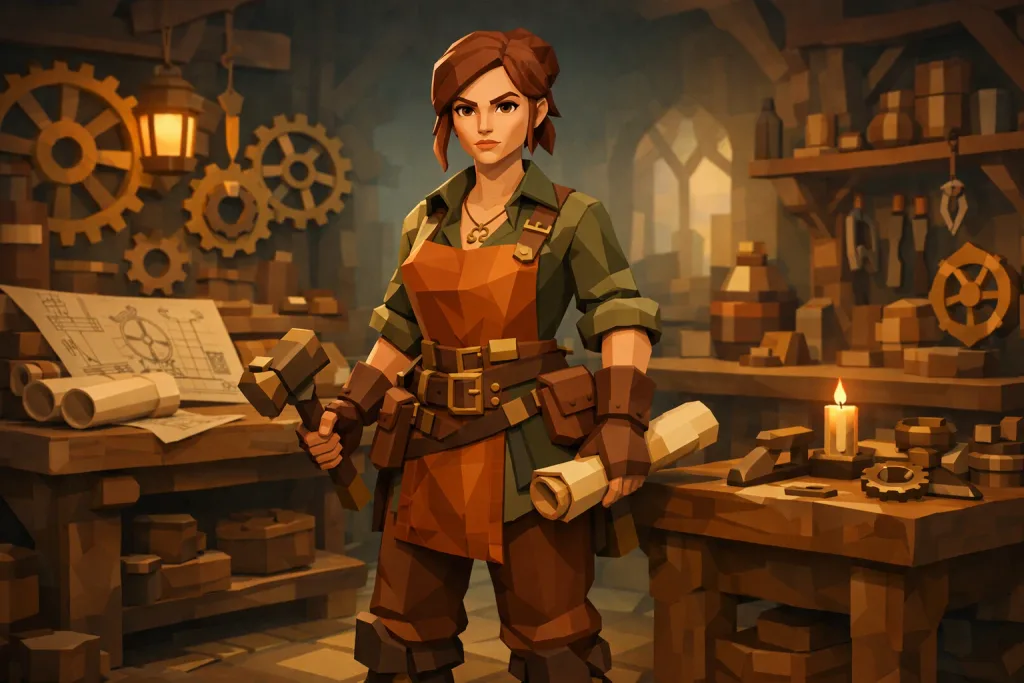
Builder
Practical and steady
You want concrete examples and a steady pace. You like to build understanding step by step through practical cases. Quiet focus helps you integrate what you learn.
Core Strengths
- check Applied learning
- check Stepwise mastery
- check Practical reasoning
- check Self-paced depth
Ideal For
- arrow_forward Skill development
- arrow_forward Case-based learning
- arrow_forward Practical frameworks
- arrow_forward Craft and practice
Intellectual DNA
Already know your style?
Download the IdeaDrip appOverview
You learn like a craftsperson: you want to see it done, try it yourself, and slowly build competence. You prefer stable progress over flashy breakthroughs, and you gain confidence when examples stack into intuition.
Key insights
You trust ideas that show up in real situations, not just in theory.
Your main risk is staying in examples without extracting the reusable pattern.
Your best growth lever is a simple “pattern sentence” after each case.
Your learning operating system
- Case-first: examples help you feel the shape of the idea.
- Focused path: you like a clear progression and skill ladder.
- Slow-burn: repetition and practice deepen the intuition.
- Internal processing: you prefer private reps over public performance.
Common friction patterns (and what they’re really about)
- Example addiction: wanting another case instead of extracting the pattern.
- Slow abstraction: the principle arrives late, which can limit transfer to new situations.
- Over-cautiousness: delaying attempts until you feel “ready.”
- Stalling on setup: tools, environment, and perfect resources become the project.
When you feel stuck, try this
- After any example, write: “In general, when X, do Y because Z.”
- Practice with constraints: fewer steps, smaller scope, shorter time box.
- Ask: “What’s the smallest version I can build today?”
- Reverse engineer: start with an output and trace backwards to inputs.
Try this week
Experiments to Try
Pattern sentence after each case
TryWhy: It turns examples into transferable knowledge.
- 1. Pick one example you like.
- 2. Write one sentence that generalizes it.
- 3. Test it on a second example and refine.
Minimum viable practice
TryWhy: It keeps momentum when you don’t feel ready.
- 1. Choose a tiny version of the skill (5 minutes).
- 2. Do it imperfectly once.
- 3. Write one improvement you’ll try next time.
One tool, one week
TryWhy: It reduces setup churn so practice can accumulate.
- 1. Pick one tool or method you’ll stick with.
- 2. Use it for every rep this week.
- 3. Only evaluate after you’ve done 5 reps.
Deep insights
You trust what works in practice
Claim
A concept becomes real for you when you can see it applied in a concrete case.
Because
Examples-first learning builds understanding through lived detail and repetition.
Watch Out
Without extraction, examples don’t transfer to new situations.
Try This
After each case, write one general rule you can reuse.
Reflection
"What’s the reusable pattern here?"
Practice compounds for you
Claim
Steady reps change your intuition more than occasional bursts.
Because
Slow-burn pacing rewards repetition and incremental improvement.
Watch Out
If progress feels invisible, motivation can dip.
Try This
Track one simple metric (time spent, reps done, examples solved).
Reflection
"What did I do one more time today?"
A clear path keeps you stable
Claim
When the next step is obvious, you can focus on doing the work.
Because
Focused learners benefit from predictable sequences.
Watch Out
If the path is unclear, you may procrastinate by gathering more resources.
Try This
Write a 3-step ladder: easiest case → normal case → stretch case.
Reflection
"What’s the next easiest step?"
This profile describes learning preferences, not intelligence, identity, or destiny. Preferences change by topic, mood, and context. Treat it as a starting hypothesis: keep what fits, ignore what doesn’t, and adjust your settings over time.
Start learning as a Builder.
Download IdeaDrip to build a personal knowledge library tailored specifically to your Builder archetype.
Free to start. No credit card required.